Ultralearning startups
What motivation and ultra-learning helped me see about learning to become a founder.
A couple of years ago, Root invited me to give a lunch-and-learn talk about motivation and learning. I used my own journey into stumbling into startups as the example. The idea I wanted to share was that learning to set up the game (aka metacognition): deciding what you want to learn, understanding what it involves, and creating a structure that helps you practise deliberately.
For me, learning to become a startup founder (with no prior experience working in tech) meant taking a my passion for learning, broad ambition to do good in the world and find sustainable ways I could actually work on for decades to have a real impact and improve peoples lives and relationship with learning. I wanted to think clearer, articulate myself simply, make good decisions, learn to bring great people along on that journey and understand which tools to use when to achieve shared goals.
Learning to "sett up the game" gave me a way to turn those intentions into a real world learning project, which became Mindjoy.
The reason you want to learn shapes how you learn
Ryan and Deci begin their paper on motivation with a wonderfully plain sentence: “To be motivated means to be moved to do something.”
They distinguish between the amount of motivation we have and its orientation: the reason we act. Two people might put the same effort into a task, with one driven by curiosity and the other by a need for approval. From the outside, their behaviour might look similar. Their experience of learning can be quite different.
Intrinsic motivation means doing something because the activity itself is interesting or enjoyable. Extrinsic motivation means doing it for a separate outcome. Ryan and Deci connect intrinsic motivation with high-quality learning and creativity, while showing that extrinsic motivation takes several forms.
This matters when learning startups. Some parts of the work may genuinely interest you. Others need doing because they serve something you value. Expecting to enjoy every task would make for a rather fragile learning plan.
The motivation scale in their paper helps make those differences visible:
- A motivation: I have no intention to act, perhaps because I cannot see the value or believe I can succeed.
- External regulation: I act to meet an external demand or receive a reward.
- Introjected regulation: I act to avoid guilt or anxiety, or to protect my pride.
- Identified regulation: I accept the personal importance of the activity.
- Integrated regulation: The activity fits with my other values, even though I am doing it for an outcome.
- Intrinsic motivation: I do the activity because I find it interesting or enjoyable.
These are different orientations, rather than steps everyone must complete in order. A useful question for my learning is whether I understand and accept why I am doing something. That gives me more to work with than simply telling myself to try harder.
Autonomy, competence and connection give motivation somewhere to grow
My original sketch grouped motivation around autonomy, mastery and purpose. Ryan and Deci’s terms are autonomy, competence and relatedness. The distinction matters: purpose can help me value an activity, while relatedness concerns feeling connected to other people.
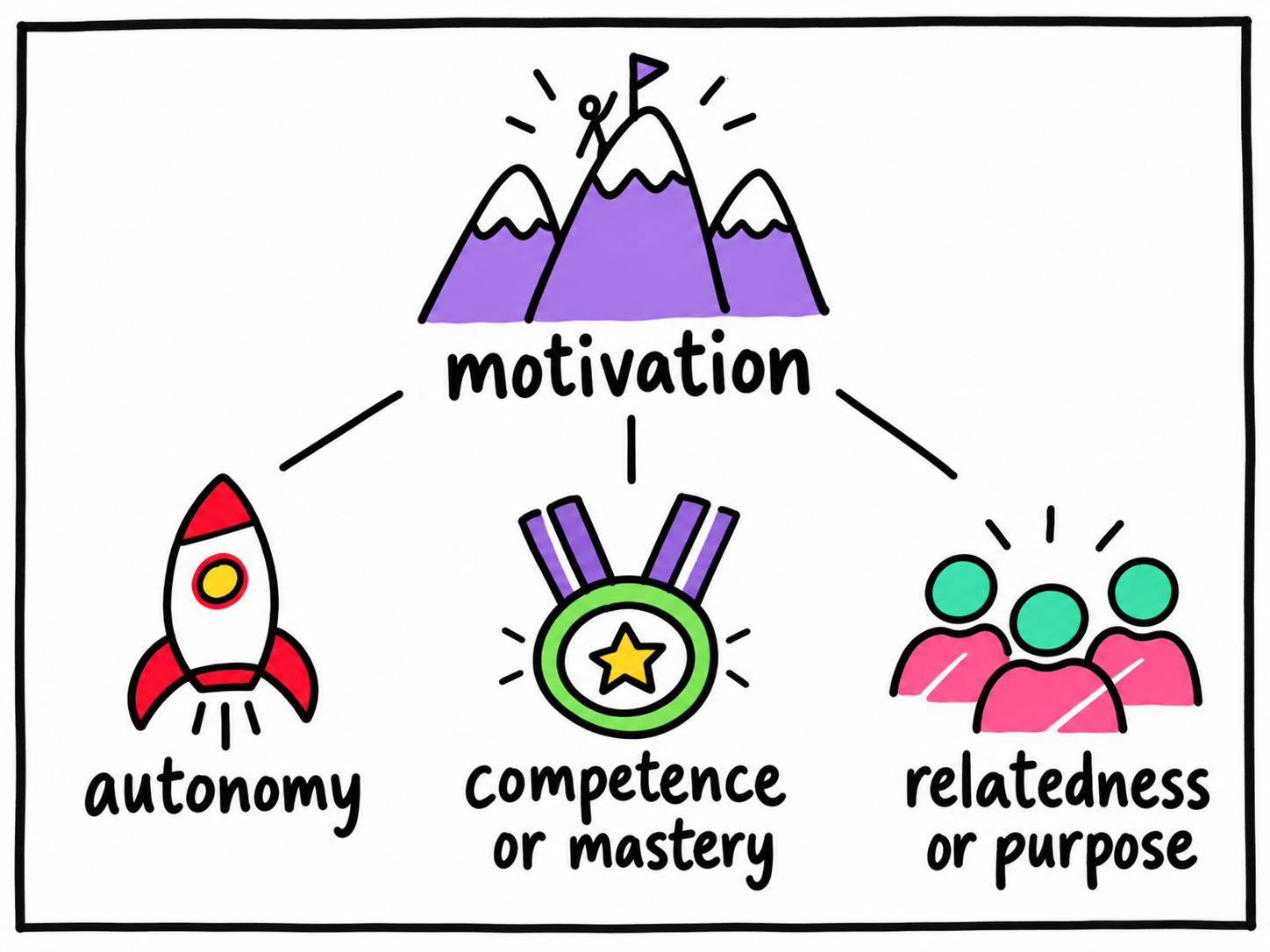
Autonomy means experiencing choice and ownership in what I do. Ryan and Deci describe how controlling environments can undermine intrinsic motivation, while opportunities for self-direction support it. Setting up the game needs to leave room for decisions I can genuinely own.
Competence means feeling effective and able to develop. Challenges and feedback can support that feeling, particularly when they come with autonomy. In my notes, I thought about learning the piano: an apparently unattainable goal can be discouraging, while something too easy can quickly become boring. I want a challenge I can engage with and a way to recognise progress.
Relatedness helps explain why we take on activities that are not inherently enjoyable. We may value them because people we care about value them. Ryan and Deci describe connection, competence and autonomy as important conditions for internalising those reasons.
For a learning plan, that suggests making the rationale clear, choosing work I can meaningfully attempt, and finding people with whom I can discuss it. A schedule alone cannot supply all of that.
Other people can help direct attention, with limits to what the evidence tells us
I also brought a paper on social contagion into the talk. Hodas and Lerman studied how people shared links on Twitter and Digg. They did not study learning or motivation, so I use the connection loosely.
Their findings emphasise visibility. A message can disappear down a feed before someone notices it. Once visibility was accounted for, repeated exposure increased the likelihood of sharing, and explicit signals of friends’ recommendations amplified the response.
The useful prompt for me is about attention. Sharing a learning goal, bringing a piece of work into a discussion, or asking someone to look at a decision could help keep that work visible. The study does not establish that these things improve learning. It offers a reminder that putting information somewhere and having someone attend to it are different events.
The language of progress should leave room for another attempt
In my notes, I contrasted traditional meanings of failure, success and mastery with navigational meanings. I wanted language that would help me decide what to do next.
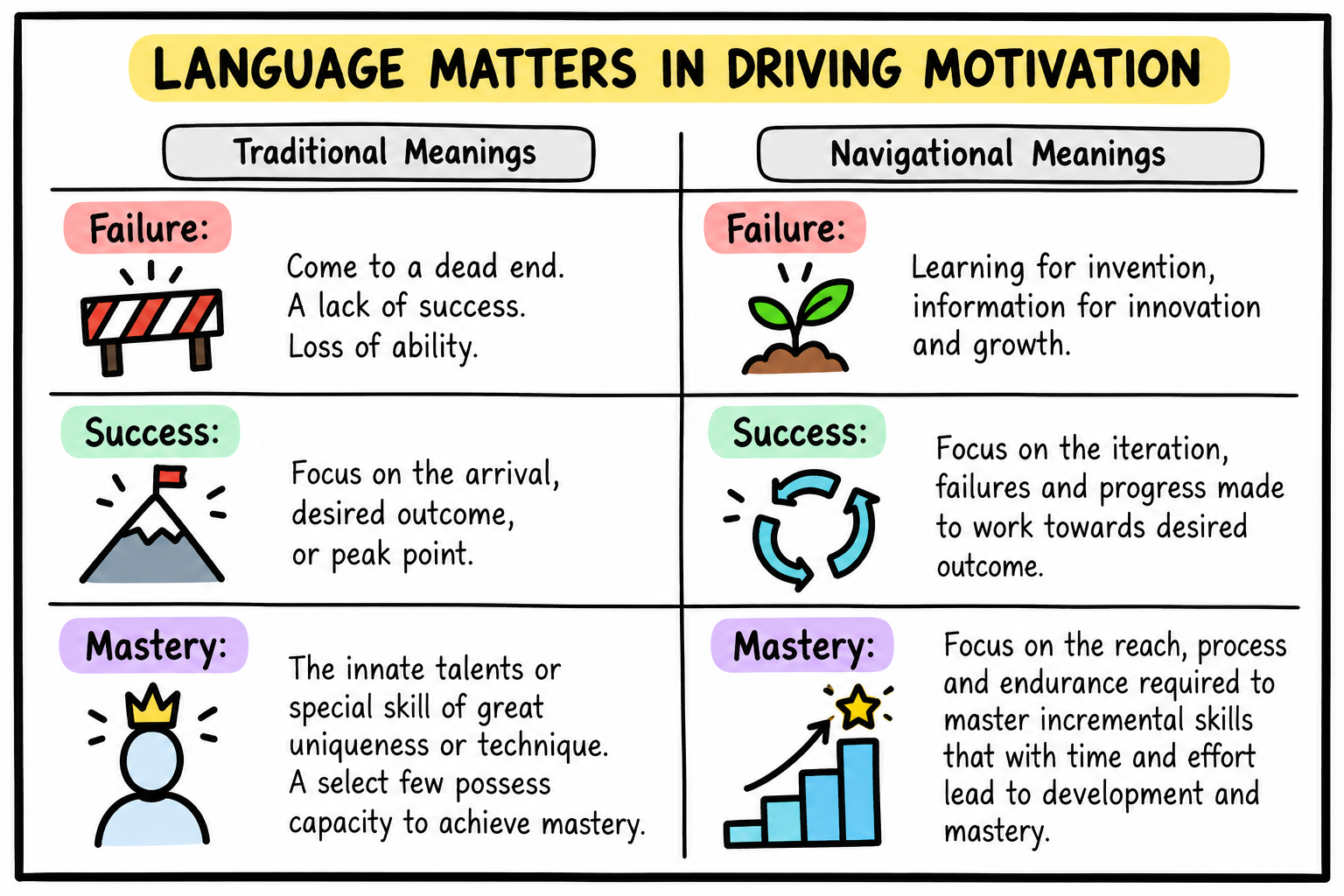
This is how I want to approach learning to become a founder. An attempt gives me something to examine: what I understood, what I missed and what I might change.
The learning loop I drew moves through discovery, interpretation, ideation, experimentation and evolution. It gives reflection a place alongside action.
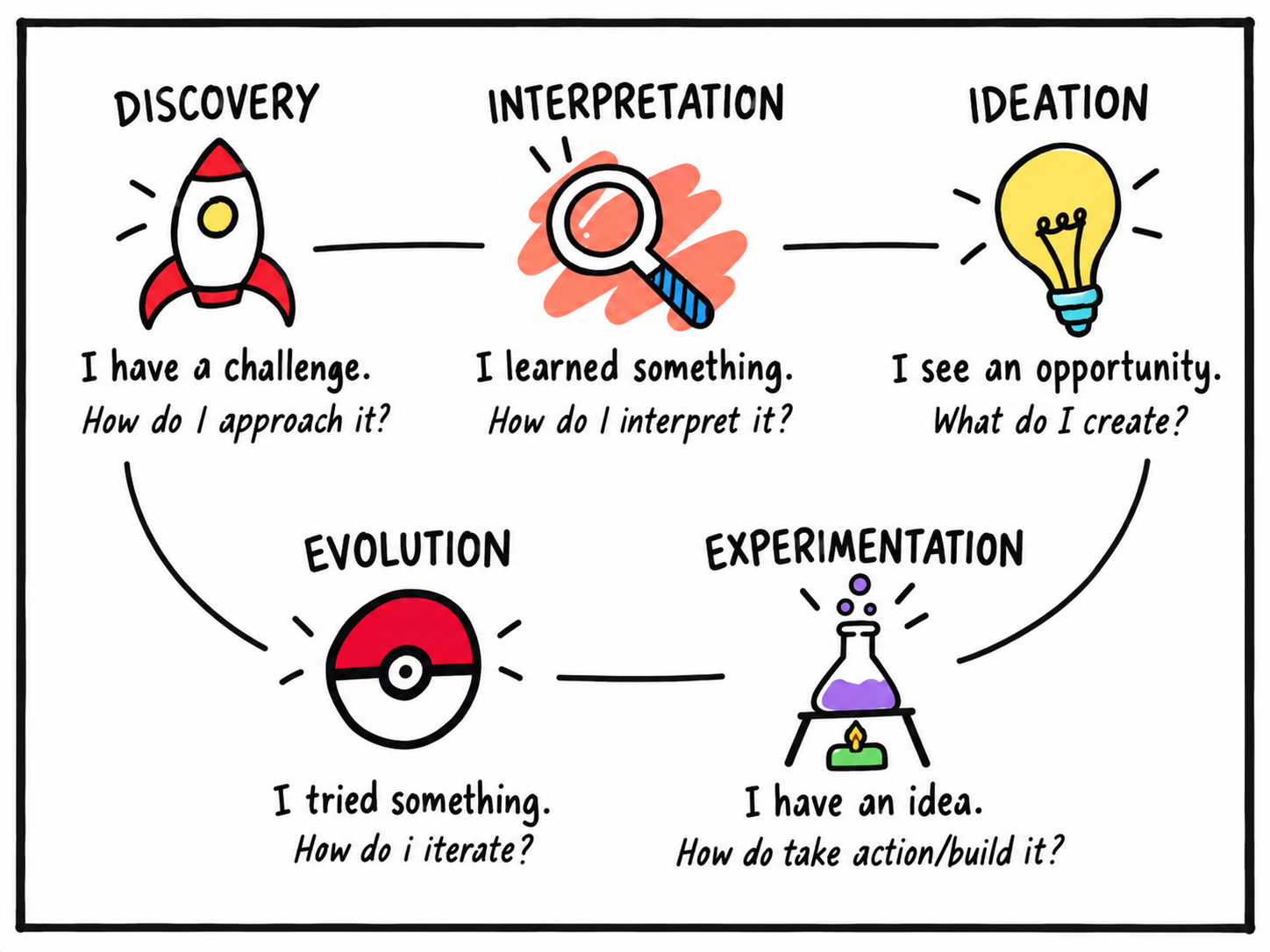
I begin with a challenge and consider how to approach it. Then I interpret what I have learned, identify something I could create, take action and review the attempt. From there, I can iterate. Setting up the game includes making time for that whole loop.
Ultra-learning makes a broad ambition into a real world project
Scott H. Young’s Ultralearning gave me another way to organise the work. The book presents an approach to learning hard skills deeply and quickly, with nine principles for planning and carrying out a learning project.
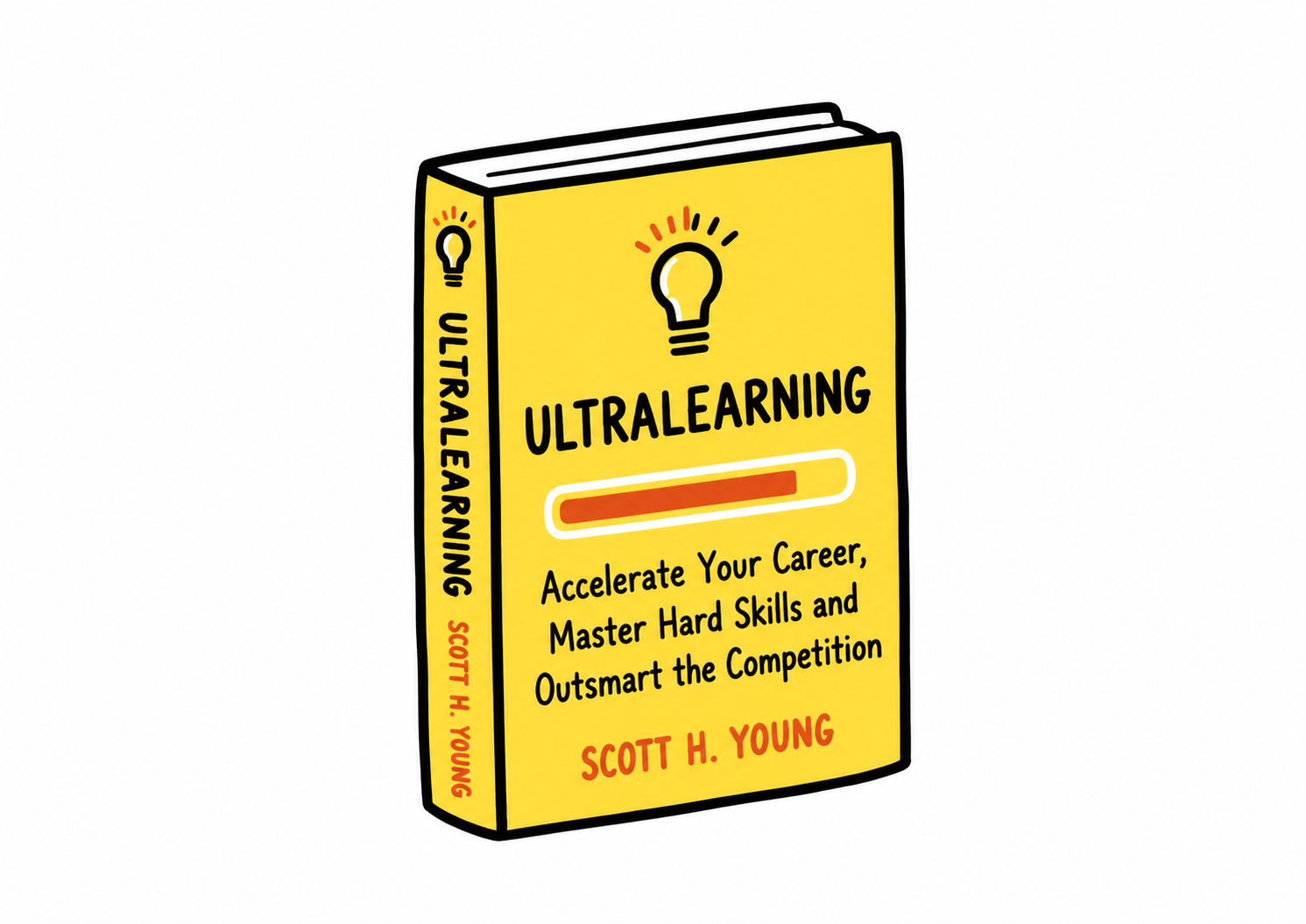
My shorthand was: do your research, schedule your time, execute your plan, review your results and embed a selected skill.
The nine principles gave that outline more detail:
- Meta-learning: Draw a map first
- Focus: Sharpen your knife
- Directness: Go straight ahead
- Drill: Attack your weakest point
- Retrieval: Test to learn
- Feedback: Don't dodge the punches
- Retention: Don't fill a leaky bucket
- Intuition: Dig deep first, then build up
- Experiment: Explore outside your comfort zone
I use these as prompts for setting up the game. They help me ask whether my activity fits my goal, whether I am attending to a gap, and whether I have a way to review the result.
For example, Instead of wanting to become a better product thinker, I can focus on making my assumptions explicit. I can share a product decision with another team-member or a great product thinker, explain the evidence behind it, and ask which assumptions are weakest. That helps me identify gaps in my reasoning before committing resources.
A totally different example might be is instead of wanting to become better at sales, I can focus on understanding why prospects hesitate to buy. After a sales call, I can review the conversation with someone experienced and ask where I missed an opportunity to uncover the real objection.
Learning startups becomes more manageable when I separate the role from the skills
My founder sketch-note began with what I wanted to achieve. It included a clear vision, the ability to explain why the work mattered, better reflection and the discipline to put time into good decisions.
It also recorded gaps: articulating a view of the future of education, understanding my strengths and what I brought to the table, and defining what winning would look like and by when.
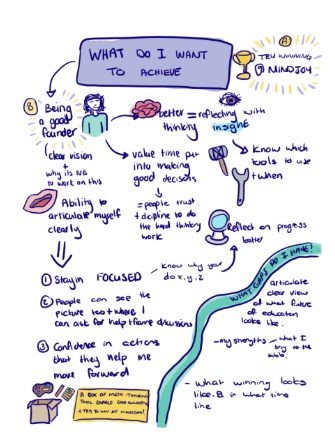
Those are still broad intentions. Setting up the game means choosing a part to practise and deciding on a daily, weekly or monthly cadence. I called this startup gym. The name helped me think about returning to the work regularly.
I also wanted some distance between myself as a person and the role I was learning to perform. Gabi the learner could practise being a founder. Startups were the domain; product management could be a subject within it; managing teams, planning and mapping workflows were more specific competencies.
That separation gave me a way to examine an attempt without making it a judgement about my whole identity. It also helped me look at how I was learning: whether the practice was useful, whether I was reflecting with insight, and whether I needed a different approach.
That is the second half of the idea, which I called the meta-game. Putting in the work is your best shot at mastery, but input does not equal output. Alongside the habits and discipline of a good player, you also want to get better at how you learn the game itself. In my case I called that meta-foundering. Setting up the game includes reviewing the structure as well as doing the work.
What I asked the room to try
My invitation to the room was to choose something small enough to begin, and give it a structure.
- Name a skill you want to develop and why it matters to you.
- Map what it involves, including one gap you want to work on.
- Decide when you will practise and how you will review an attempt.
- Bring something into a discussion so someone else can see the picture and help.
Sources
- https://selfdeterminationtheory.org/SDT/documents/2000_RyanDeci_IntExtDefs.pdf
- Hodas, N. O. & Lerman, K. (2014). The simple rules of social contagion. Scientific Reports, 4, 4343.
 Scott H. Young